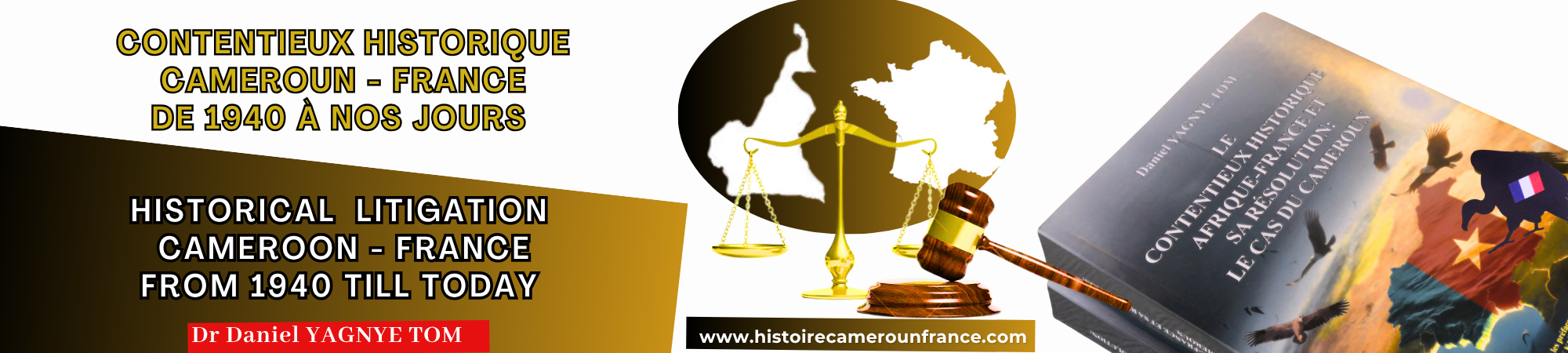
The historical dispute between Cameroon-France is not limited to the period before independence, as the French presidents, François Hollande and Emmanuel Macron, would want us to believe. It goes well beyond, from the French presence as of 1916 until 2022, with French economic empires based for decades on Cameroonian territory, and whose benefits are totally unknown to almost all of the Cameroonian entire state and its people.
To explain and expose this game, we have to open up briefly, a part of the activities of the « sulphurous » Vincent Bolloré together with his « neocolonial Cameroonian » empire which hides an impressive transnational mafia network (both civilian and military).
On the website of « Bolloré Transport & Logistics Cameroon » one can find the following, very « nicely » published, but without any further details:
« Bolloré Transport & Logistics Cameroon was created in 1947.
Our National General Directorate is based in Douala:
1. In addition to the port of Kribi, Bolloré Transport & Logistics operates
2. the Douala–Ngaoundéré railway line. This strategic artery connects the economic capital of Cameroon to major cities such as Yaoundé in the hinterland.
3. Our organization offers complete end-to-end solutions to our customers, including air and sea freight (FCL/LCL container),
4. land transport,
5. customs brokerage,
6. storage and distribution,
7. as well as many other value-added services.
The company has a wide range of capabilities and experienced staff to handle all types of cargo up to oversized equipment, with specific expertise in a number of verticals such as:
8. Mining
9. humanitarian aid,
10. Oil
11. gas,
12. food,
13. beverages,
14. industrial projects,
15. technologies,
16. energy,
17. non-metal commodities.
Behind these « pretty words » lies a sordid, abject and hideous reality. This multinational has happily prospered in Cameroon, thanks to some very high local criminal complicities, and all of that, to the detriment of the Cameroonian people.
Indeed, who can say exactly what the real activities of the Bolloré group have been and still are, for several decades in Cameroon?
Between nominees and fake front-men, shenanigans, privileges, influence peddling, intimidation, deception, extortion, destruction of the environment, spoliations, embezzlement, imprisonment, rapine, impoverishment of populations for the interests of the French multibillionaire Vincent Bolloré and his Cameroonian accomplices, a silence reigns: oppressive, asphyxiating, slimy, intolerable!
In 2022, few can tell us exactly how many hundreds of billions of CFA francs have left Cameroonian territory, with impunity, under the cover of occult, illicit activities, the unimaginable nature of which the general public cannot fathom or even fully comprehend.
Most ironically, Vincent Bolloré, this « golden boy », powerful supporter of the French racist Far Right on his television channel CNews, boasts of « sincere friendships » with powerful Africans, especially in Cameroon. Just Normal, and according to the newspaper Le Monde of April 07, 2016, it is in Africa that this behemoth makes 80% of its profits.
« Mr. Vincent Bolloré, who faces several complaints, for his methods worthy of the slave period in Cameroon and elsewhere, has been for decades a heavyweight of the Cameroonian economy. Le Monde Diplomatique in its publication « Port, rail, plantations: the sad balance sheet of Bolloré in Cameroon » of April 2009, writes:
« Thanks to the acquisition of old French colonial companies and the privatization of a significant part of the national economic heritage, the Bolloré group has become a key player in the economic fabric and political life of Cameroon:
- Concessionaire of the railway company CAMRAIL since 1999 (until 2034),
- It obtained the concession of the container terminal of the port of Douala in 2005 (until 2020).
- Its various agencies, grouped under the brand « Corporate Bolloré Africa Logistics » since September 2008, are present in the economic capital, Douala, in the political capital, Yaoundé and in the north of the country, in Garoua.
- The management of all production flows of aluminum produced at the Edéa plant, managed by the Canadian giant Rio Tinto-Alcan,
- the logistics of the construction of the Chad-Cameroon pipeline, operated by Exxon-Mobil,
- « Door to Door » logistics on behalf of Total are among the Cameroonian « references » that the group prides itself on its website.
If he abandoned the logging sites after having participated, according to some NGOs, in the « looting » of Cameroonian forests,
- the group still manages a wood park, thanks to its Société d’Exploitation des Parcs à Bois du Cameroun (SEPBC). (100,000 m² platform managed by SEPBC)
- It also controls huge plantations, either directly, through SAFACAM which operates 8,400 hectares of oil palm and rubber trees, or indirectly, via the Belgian company Socfinal, which manages 31,000 hectares of oil palm trees in the country.
- Bolloré Group officials swear not to « control » Socfinal’s plantations. This is disputed by most observers.
We are adding the « Kribi Logistics Hub », inaugurated in June 2022, a modern logistics base with a total surface area of 24,000 m2, located near the port of Kribi. According to a press release from the Bolloré group: « This platform aims to receive, store and deliver goods for both import and export. »
The strategic (military) activities of Vincent Bolloré.
In Jean Bothorel’s book, “Vincent Bolloré, une histoire de famille, Jean Picollec, Paris, 2007″, Vincent Bolloré declares: « and only in sectors where no one wants to venture; for example, transport in Africa, where we are the only players. All this represents a few tens of millions of euros, that is to say less than 1% of our turnover. »
This is the military and strategic sector. According to Le Monde Diplomatique of April 2009, the Bolloré group: « Reference operator on all African transport routes« , as it likes to present itself, can therefore evolve both in times of peace and in times of war: As « residual » as they are, these public contracts – particularly with the ministries of foreign affairs or defense – are generally based on strategic interests. When France sends – or repatriates – troops to Africa, as for Operation Licorne in Côte d’Ivoire, many subsidiaries of the Bolloré group often appear indispensable. « All operations are carried out with the strictest security and confidentiality » the reads, superimposed on images of armored vehicles, on a leaflet distributed by the « Defense » branch of SDV…
« The United Nations frequently uses his services when it sends peacekeepers. And Bolloré intervened as part of the European Union Force (EUFOR) sent to Chad. In Sudan, an oil country ravaged by years of violence, its subsidiaries are, by the admission of their managers, doing profitable business simultaneously in humanitarian logistics… and oil. ) Cf. « Les bonnes affaires de Bolloré », Marchés tropicaux et méditerranéens, Paris, 25 January 2008.
For Le Monde Diplomatique, « The African Wars of Vincent Bolloré », in its April 2009 publication: « The Bolloré Group is indeed the owner of several companies that made their fortune, during the colonial era, in the transport, transit and handling of import-export products with the continent.
The two main ones are the Société commerciale d’affrètement et de combustibles (SCAC) on the one hand, bought in 1986 and subsequently merged with other branches of the group to give birth to SDV Logistique internationale; and on the other hand, SAGA, twin sister of the previous one, bought after many intrigues in 1997.
It must be said that with the advent of privatizations imposed on African States by international financial institutions, under the leadership of the International Monetary Fund and the World Bank with their Structural Adjustment Program, Vincent Bolloré has carved out the lion’s share in Africa. There are port concessions, roads, waterways, railways, logistics bases, oil and gas terminals, in short:
« Strategic infrastructures also inherited from the colonial era – In connection with the two hundred agencies that the group has in forty African countries, and with its railways, thousands of trucks and millions of square meters of storage space, port management ensures the Bolloré group a formidable hold on the continent. Under the umbrella brand « Bolloré Africa Logistics », created in September 2008, it has become the « first integrated logistics network in Africa »
Nicknamed « Smiling Killer », Vincent Bolloré has woven powerful networks in Africa in order to gain ground. « The ministers, we all know them there, » says the group’s CEO Gilles Alix. They are friends. So, from time to time — I will be clear — they are given, when they are no longer ministers, the opportunity to become directors of one of our subsidiaries. It is to save their face. And then we know that one day they can become ministers again. »
It is thus almost impossible to know the mafia connections of « FrançAfrique » inherited from the colonial era, which bind the Bolloré group, French politicians and African leaders, all mired in vast and dark systems and networks of corruption.
Even more spectacular, it is this statement, which is found in the book by Aymeric Blanc and Olivier Gouirand, « The concession of the railway in Cameroon: the paradoxes of an unpopular success » (PDF), August 2007 « Africa is like an island, connected to the world by the seas, » explained a former Bolloré group member in 2006. So, whoever holds the cranes holds the continent! ». This sentence summarizes in a few words what we will not cease to denounce, as the very source of the « HISTORICAL CAMEROON – FRANCE DISPUTE », the stranglehold of the France on Cameroon by an implacable and intolerable mechanism that prevents its daughters and sons from enjoying the natural and human wealth for the development of Cameroon:
« And all the more so since Cameroon, a former territory under French trusteeship during the colonial period, remains managed by a local elite which, heir to an independence drawn by the French themselves, acts more according to its own interests than to the general interest. While the leaders of the Bolloré group frequently appear with President Biya, his wife Chantal or some other senior officials of the regime, many Cameroonians wonder how far Bolloré’s interference in the internal affairs of their country goes. Bolloré is a perfect illustration of Françafrique! ». Monde Diplomatique – April 2009… Simply edifying and sickening!
Dr. Daniel Yagnye Tom
President of the Patriotic Alliance and Special Representative of the UPC
In Southern and Central Africa.