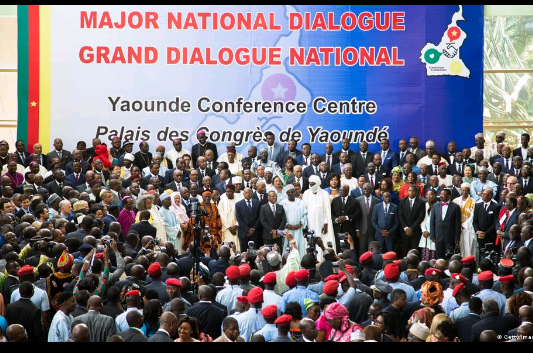
(English Version) – Declaration of the Patriotic Alliance following the holding of The Major Inclusive National Dialogue.
The Patriotic Alliance, since its birth, has made the holding of a real Inclusive National Dialogue (IND) for the resolution of Historical Disputes its battle horse, as conferred by the various outings of its members in the media and its statements during Celebrations of our national heroes.
On September 10, 2019, the Head of State finally acknowledged, in a speech to the nation, the existence of this National Historical Litigation and convened an Inclusive National Dialogue (IND). The Patriotic Alliance, in its statement of September 13, 2019 on the occasion of the commemoration of the father of Kamerunian independence Ruben Um Nyobe, also welcomed this recognition as well as the summoning of the IND by the Head of State. At the same time, the AP deplored the fact that this dialogue took place in the context of war; Thus, ignoring the experience of conflict resolution elsewhere in Africa and around the world. In particular the prerequisites for such a dialogue which are:
- A ceasefire declaration by the government;
- A general and unconditional amnesty;
- The release of all political prisoners.
Through this regret, the AP implicitly expressed its reservations on the approach of the President of the Republic as well as his limits as to the satisfaction of the expectations of the Kamerun people with regard to the resolution of the crisis in the North West and South West regions. As it is true that the main belligerents like Mr. Ayuk Tabe were not invited to the discussion table. In addition, the participants in committee work were tailor-made by the government with a strong dominance of members of the CPDM and its satellite parties. For the Patriotic Alliance, the results of this dialogue, which was akin to a monologue, are in themselves mixed.
It appears from the outline of the recommendations that the National Historical Litigation was only approached in an imprecised and superficial way since it was a charade reduced to just the problem of bilingualism as it is practiced and to the imported educational and judicial systems. The crisis in the North-West and South-West regions, however, finds its source in the non-resolution of the National Historical Litigation, the main constituent elements of which are:
- The depraved conference of Foumban in 1961 which marks the beginning of the long process of annexation of West-Kamerun.
- The pseudo-referendum of 1972. In itself a coup de grace with a strong smell of oil and under the influence of France.
- The unilateral return to the Republic of Cameroon by Mr. Paul Biya.
It would, therefore, not have been reduced to a question of Francophone or Anglophone, more so as there is neither a Francophone ethnic group nor an Anglophone ethnic group in Kamerun.
By emphasizing the need to strengthen bilingualism centered on French and English instead of placing particular emphasis on multilingualism which would place our national languages on the same footing as the colonial languages, the participants in the Grand National Dialogue (GND) not only denied themselves, but also and above all denied the Kamerunian national entity, thus demonstrating their non-recognition of its human and cultural identity. Attempting to maintain and the desire to strengthen the two educational and judicial subsystems both fall squarely under the same logic. Obviously, there is no political will to definitively resolve the schism in the educational and judicial systems in Kamerun by creating on the one hand, an endogenous educational system, and on the other a purely Kamerunian judicial system anchored in our cultural values. It is as if the path to development passes through self-denial and submission to the foreigner.
Instead of definitively resolving the National Historical Dispute by attacking the nature and form of the State, the participants in the GND chose instead to headlong rush by granting a bounty to those who took up arms. The special status recommended for the North-West and South-West regions does not solve the fundamental problem, which is that of a real change in the relationships and dynamics between the center and the periphery, between the central State, the local authorities and the citizens.
Will the North-West and South-West regions benefit from the effective participation of local communities in the design of economic, social and cultural development policies while the others will not? Will there be in these two regions a reinforcement of the capacities of action of the local communities by a political, legal, financial and administrative autonomy while that will not be the case elsewhere as well? Do armed groups have to spring up all over the country to make themselves heard?
Nevertheless, the Patriotic Alliance,
- Welcomes the release of the hundreds of political prisoners arrested in the context of the NoSo and post-election crises, but regrets at the same time that this presidential pardon has not been extended to the recently sentenced leaders of West Kamerun.
- Appreciates the recommendations on the reintegration of ex-combatants, but at the same time deplores the fact that the families of war victims have been forgotten.
- Welcomes the concern to take measures aimed at granting a general amnesty to encourage the return of refugees and displaced persons.
- Welcomes the proposal to create a High Council of the Diaspora and the principle of representation of the Diaspora at parliamentary and governmental levels. However, we dare to believe that the representatives of the diaspora will not only be chosen from the offices of the UC-UNCRDPC.
- Welcomes the desire to reform the nationality code with a view to allowing the Cameroonians of the diaspora to be able to have dual citizenship.
- Takes note of the proposals for the reconstruction and development of West-Kamerun and recalls at the same time that almost all of Kamerun is affected. The Far North (particularly the following villages: Magdeme, Double, Fotokol, Bodo, Sagme, Kangaleri, Kerewa, Ashigashia), the East and several rural areas in the Centre, the South, the Littoral and across the rest of the country are sorely lacking in road, school, medical and health infrastructure, water, electricity, etc. These areas also deserve special attention. It is all of Kamerun that requires a construction and development plan.
In view of the mixed results of the GND, the Patriotic Alliance,
- Reaffirms its attachment to the construction of a federal kamerun which considers the aspirations of the local populations by changing the relationships and dynamics between the center and the periphery, between the central State, the local communities and the citizens. A State which, through a visionary and intelligent policy, offers prospects and opportunities for development in all areas of society.
A federal Kamerun which, on the politico-administrative level, will be based on the following levers:
- A consensual and non-exclusive policy i.e. which includes all the components of society of the State to the individual, from its conception to its application.
- A participatory democracy of citizens. We cannot wipe out the conscience of the people we lead. In a new Kamerun, the citizen must therefore be encouraged to participate actively in the construction of localities at all levels.
- The use and integration of local languages at our institutions. Most citizens have the feeling of being excluded from the political and institutional process due to the lack of mastery of imported languages. Moreover, a self-respecting people does not identify with a colonial language.
- Effective participation of local communities in designing federal economic, social and cultural development policy through their representatives in the federal parliament.
- Strengthening the capacity for action of local communities through the political, legal, financial and administrative autonomy of these communities. Naturally, this reinforcement goes without saying with a reinforcement of their strategic resources, especially financial, through a tax reform. This tax reform which is absolutely essential in the case of the current Kamerun must be dependent on the attributions of the municipalities, regions/federated states and the Federal State. For example, 30% of the tax revenue in a communal locality could be transferred to the federal level, 30% to the regional government and the remaining 40% of the revenue will be managed locally. Wealthier communes within the same region supporting poorer communes within the same region through a cash transfer mechanism as needed. Mechanism to be administered at the regional level by the regional administration under the control of the regional parliament. At the federal level, a similar mechanism should be set up to support the poorest federated states.
- A federal parliament which draws up and votes on laws, the federal budget, controls and ratifies the action of the federal government. It can table or depose it if necessary.
- Regional parliamentarians who draw up and vote on laws and the budget at the regional level. They control and ratify the action of the respective regional government (or federated state) and can table it if necessary.
- Locally elected officials who draw up and vote on the budget at municipal level. They control and ratify the action of the mayor who is himself an elected official. Local elected officials can depose the mayor if necessary.
- Region Government: Each federated state/region will have at its head a government headed by a prime minister or a regional governor who is elected by the populations of the federated state that he leads and governs.
- A restricted Senate composed only of the prime ministers or governors of the regions/federated states.
- A national development army under the high command of the Federal President. Its main role will be the protection of the people. In times of peace, it may engage in infrastructure construction activities, such as roads, bridges, hospitals, etc.
- The police force close to the people whose main role is to ensure security and to fight against crime and prevarication. There will be the federal police force whose role will be to secure the national borders and a regional police force in each region or each federated state. The security of property and people in each federated state / each region is the responsibility of the regional police.
- Federal customs under the direction of the Federal Bureau of Customs. Its presence must be effective in all the entry and exit doors of Kamerun. Customs revenue will be transferred directly to the Federal Ministry of Finance.
- Reiterates its appeal to the Kamerun people to mobilize for the creation of a vast Popular Movement by organizing themselves in action committees in order to put an end to the war in the North-West and South-West regions and resolve, once and for all, the Historical Litigation.
Done in Yaoundé, this 07.10.2019
The Presidium of the Patriotic Alliance


