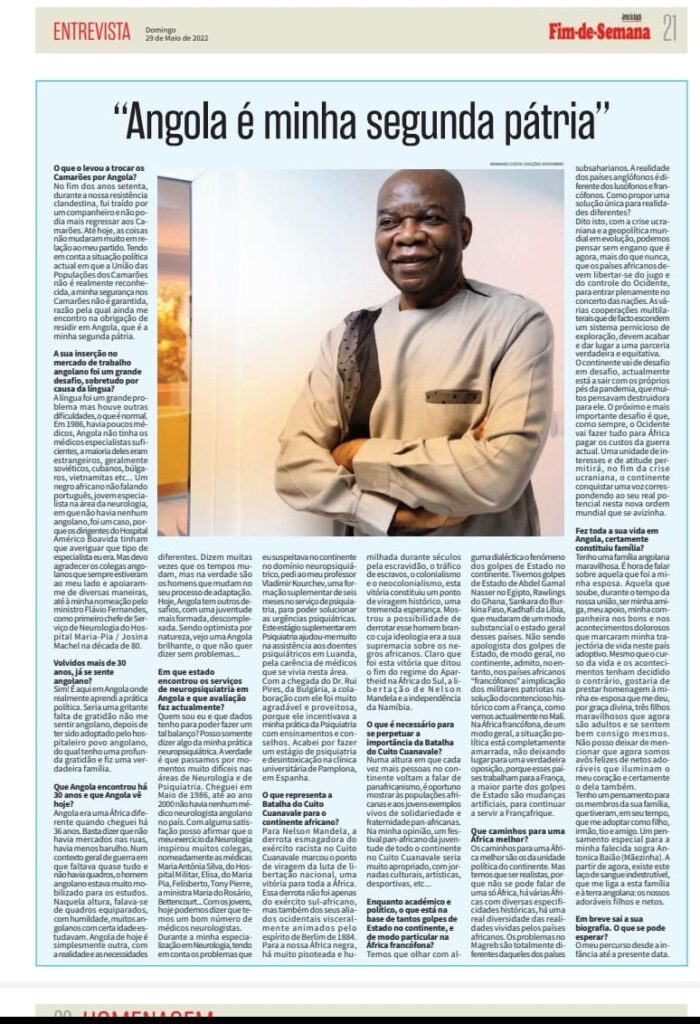
« JORNAL DE ANGOLA »: INTERVIEW WITH DR YAGNYE – PAR ANDRÉ SIBI. (29 May, 2022 – English Version of Initially French Translated Version)
Dr. Daniel Yagnyè Tom, a Cameroonian neuropsychiatrist trained in Russia and exiled in Angola since 1986, tells his experience in this country and the situation on the African continent. Born in Douala – Cameroon, Daniel Yagnyè Tom considers himself an « Angolan at heart », a Pan-Africanist and a man of convictions.
Interview with André Sibi.
Under what circumstances are you travelling to Russia for your higher education?
It was one of the hardest times of my life. I was already a student at the Faculty of Sciences of the only University of Yaoundé – Cameroon at that time. But very keen on studying medicine, my parents did not have the financial capacity to facilitate my entry into the only health school in the country at the time: The University Center of Health Sciences (C.U.S.S). Though admission was officially offered through a competitive exam, the reality was much more complex than that, given that entries were also made possible via other various channels. I had already participated in two of such entry exams without success. Fortunately, with the help of my uncle, Captain Michel Makanda, I was able to obtain a scholarship for medical studies in the Soviet Union.
Was it easy for you to finish your studies in Russia?
It was not a smooth sail at all because in front of me were two challenges: medical school and politics. On the one hand, Russia was in full transformation and there was some political interference in education and on the other hand Cameroon, a neo-colonized country, was putting political pressure on the Soviets at the diplomatic level for follow-up on its students, which did not quite facilitate my stay in Russia at all.
What Russia did you encounter at that time?
It was the Soviet Union of Leonid BREZHNEV when I arrived in 1975. For a young African who had grown up without access to health or culture and free education, it was a gigantic discovery and a completely different society. My first years were dreamy with the encounter of socialism and Marxism-Leninism, but gradually I began to understand the specificity and peculiarities of Soviet society. My ten-year stay in Volgograd, the former Stalingrad, deeply marked my life because the whole city exuded Soviet patriotism during World War II, which was the great inspiration that radically and finally transformed my life to this day.
Apart from medical training, it is also in Russia that you started and you asserted yourself as a member of the Directorate of the Union of the Peoples of Cameroon (U.P.C)?
It was in Volgograd that I discovered Soviet heroism. After meeting an exiled uncle and member of the UPC during my summer holidays in Paris, he told me the true story of Cameroon’s war of independence and I discovered the heroism of my own parents, including that of my mother’s older brother Tina Kissaga. It was during this meeting with my uncle, Yana, that I discovered the heroism of the Cameroonian people, which turned out to be a driving force for my own activism in the Soviet Union. As time dragged on, I was later appointed as Representative for students in Eastern Europe. In 1982, after the 3rd UPC Congress, I was appointed Special Representative of the UPC in the Soviet Union as well as the countries of Eastern Europe. In 1984, at the 4th UPC Congress, I was elected a full member of the Central Committee of the UPC.
How are your relations with the Cameroonian authorities at present?
Relations with the authorities of my country are cold because of my political options which are not in agreement with those of the Cameroonian government. Put in another way, the current Head of State, after forty years of undisputed presidency, is very aged. I respect his venerable age. The Republic of Cameroon will soon begin a fundamental change in its political life. We are closely monitoring and following up on the country’s political activities.
In several of your writings, you evoke the Franco-African Historical Dispute, what is it finally?
In truth, the so-called « French-speaking » African countries have never really been independent; they have simply enjoyed a certain and limited degree of relative political autonomy. Suffice it to say, the currency used in these countries is the CFA franc which is a property of France. The concept of Franco-African Historical Litigation explains how France managed to create apparently independent African states, but in reality, completely under its dependence, through assassinations, corruption and various occult networks, France created the infamous « FrançAfrique » that was born in Cameroon, the only « French-speaking » country south of the Sahara in which horrendous genocides were carried out, inwithin the framework of an atrocious war for the conquest of independence. In truth, the monetary policy of France in these countries appears today as a challenge for the whole continent, which should mobilize us all, exactly in the same way that was done against apartheid, because it is an obstacle to the development of the whole continent.
We are currently living in a post-colonial era; would it make sense for Africans to demand compensation or reparations for colonization?
Africans should demand reparations not only for colonialism and neocolonialism, but also for the slave trade. In this world, only Africans tend to forget everything. If someone went to the United States, France or Germany and managed to rob them of their important national assets, even after centuries, these countries would go out of their way to recover their property. Thanks to our continent, Western countries have enriched themselves at the expense of Africa, with the loss of its sons and daughters, which is why compensation is essential.
Has an African state adopted your theory of “Franco-African Historical Dispute”?
It is a little bit untimely at the moment to talk openly about this concept, which is still scary in some quarters, but what is currently happening in Mali or the Central African Republic, for example, is entirely linked to the Franco-African Historical Dispute.
Africa freed itself from colonialism, fifty years after the creation of the OAU, what were its objectives?
Africa has not really freed itself from colonialism because a part of the continent is still handcuffed by neocolonialism, and typically, that is the so-called « francophone » part. That is why the OAU has not lived up to the expectations of the African peoples who dreamed of a politically united Africa. The OAU was born divided by a bad compromise between the Casablanca and Monrovia groups. And the African Union has simply inherited its fragilities and weaknesses.
What made you exchange Cameroon for Angola?
At the end of the 70s, during our clandestine resistance, I was betrayed by a compatriot and could not return to Cameroon. So far things have not really changed for my party. Considering the current political situation of my party which is not officially legalized and therefore cannot function normally, my security in Cameroon is not guaranteed, which is why I am forced to live in Angola which is my second homeland.
Your integration into the Angolan job market was a great challenge, especially because of language?
Language was a big problem but there were other challenges as well, which was just normal. In 1986, there were very few doctors. Angola did not have sufficient medical specialists, most were foreigners, usually Soviets, Cubans, Bulgarians, Vietnamese etc. A black African who could not speak Portuguese, a young African specialist in neurology, a field where there were no Angolan specialists, was quite a loaded case, since the leaders of the Américo Boavida hospital needed to be very clear-minded with regard to the professional level of this particular specialist. But I must thank my Angolan colleagues, who have always been on my side, supporting me in various ways, until my appointment by Minister Flavio Fernandes as the first Head of the Department of Neurology at the María Pia/ Josina Machel Hospital in the late 80s.
More than 30 years later, do you feel Angolan?
Yes! It was here in Angola that I really learned political practice. It would be a profound ingratitude on my part not to feel Angolan, after being adopted by the hospitable Angolan people, for whom I have a deep and profound sense of gratitude towards a real family.
Which Angola did you meet 30 years ago and which Angola do you see today?
Angola was a different Africa when I arrived here 36 years ago. Suffice to say that there were no markets and no sales on the streets, there was less noise. Inwithin the context of war during which almost everything was lacking, as well as qualified experts, the Angolan was mobilized to undertake their training. At that time, it was a question of equivalent qualified experts, and with great humility, many elderly Angolans resorted to studying really hard. Today’s Angola is simply different, with different realities and needs. Very often we talk about the change of times, that time is no longer the same as before, in reality, it is men who evolve in their adaptation process. Today’s Angola has other challenges, with a more trained and a more self-confident youth. Being an optimist by nature, I see a radiant Angola, which, of course, does not mean it wouldn’t continue to have its own normal and day to day problems.
In what state did you find neuropsychiatry practice and services in Angola and what assessment are you making today?
Who am I and what data do I have to carry out such an assessment? All I can say is simply something about my neuropsychiatric practice. The truth is that we have had very difficult times in the spheres of Neurology and Psychiatry. I arrived in Angola on May 2, 1986, and up to the year 2000, there were no Angolan neurologists. It is with real satisfaction that I can say that my practice of Neurology has aroused vocations and inspired colleagues, such as Colonel María Antonia Silva of the Central Military Hospital, Elisa of the María Pia Hospital, Felisberto, Tony Pierre, Minister María do Rosario, Bettencourt… with young people today, we can say that we have a good number of neurologists. During my specialization in Neurology, considering the problems I suspected in Africa in the neuropsychiatric field, I asked my professor Vladimir Kurchev, additional training in the Department of Psychiatry in order to improve my assistance to psychiatric patients, especially in case of emergencies. This was very useful for me here in Luanda due to the lack of psychiatrists we had then. With the arrival of Dr. Rui Pires from Bulgaria, my collaboration with him was pleasant and advantageous because he encouraged my psychiatric practice with lots of teachings and advice. Finally, I began training in Psychiatry and Detoxification at the University Clinic of Pamplona in Spain.
What does the Battle of Cuito Cuanavale mean for the African continent?
For Nelson Mandela, the crushing defeat of the racist army at Cuito Cuanavale marked the turning point in the national liberation struggle, a victory for all of Africa. This defeat was not only that of the South African army but also that of its Western allies viscerally animated by the spirit of Berlin 1884. For our black Africa, long trampled upon and humiliated for centuries by slavery, the slave trade, colonialism and neocolonialism, this victory was a historic turning point, a tantamount provider of enormous hope. It showed that it was possible to defeat this white man whose ideology had always been that of his supremacy over black Africans. Of course, it was this victory that dictated the end of the apartheid regime in South Africa, the release of Nelson Mandela as well as the subsequent independence of Namibia.
What would it take to perpetuate the importance of the Battle of Cuito Cuanavale?
At a time when more and more people on the continent are starting to talk about Pan-Africanism again, it will be key to cite to the African people and the youth live examples of Pan-Africanist solidarity and fraternity. I think that a pan-African youth festival in Cuito Cuanavale would be very appropriate, with cultural, artistic, sports days, etc.
As an academician and politician, what could be at the origin of so many coups d’états on the continent, and particularly in French-speaking Africa?
I think we should look with some dialectic at coups d’états on the continent. We had coups d’états by Abdel Gamal Nasser in Egypt, Rawlings in Ghana, Sankara in Burkina Faso, Gaddafi in Libya, which substantially transformed the general state of these countries. Not being an apologist for coups d’état in general in Africa, in the so-called « French-speaking » African countries, I, nevertheless, will submit to the involvement of patriotic soldiers in seeking a solution to the Historical Dispute with France, as we are currently seeing in Mali. In « French-speaking » Africa, in general, the political game is completely screwed and doors completely shot, leaving neither room nor space for real opposition, because these countries work for France, most coups d’états are none other than just superficial and phony changes of just facade, in order to perpetuate FrançAfrique.
What paths then for a better Africa?
The paths towards a better Africa are those of the political unification of the continent. But we must be realistic, because we cannot speak of a single Africa since there are actually several « Africas » with historical diversities, there is a real diversity of realities experienced by African countries. The problems of the Maghreb are totally different from those of sub-Saharan countries. The realities of English-speaking countries are totally different from those of the Portuguese and the French-speaking countries. How can we then forge a consensus for a unique solution in the face of all these different realities?
That said, with the Ukrainian crisis in the midst of an always evolving global geopolitics, we can safely say that now, more than ever before, African countries must free themselves of the yoke and bondage of Western control, and then fully insert itself in the concert of nations. In essence, the many forms of cooperation, which simply hide a pernicious system of exploitation, must cease and give way to a much more genuine and equitable partnership.
Our continent is also moving from challenge to challenge, as it is also and currently emerging with its own means of fighting the pandemic, which some circles thought was entirely going to wipe out Africa. The next and most important challenge we face is that the West, as usual, will do everything to ensure that Africa pays the price for the current war in Ukraine when it is all said and done. Uniting our common interests and attitudes would permit us, on the continent and at the end of this Ukrainian crisis, to speak with one voice that will be powerful enough to create sufficient leverage that can match our real and joint potential, as we enter the new world order that is emerging.
You have spent all of your entire life here, surely you have formed a family?
I have a great Angolan family. This is the time to talk about the one who was my spouse. The one who knew, from the very onset of our union, how to be my support, my companion, throughout all the good and painful moments of my life’s trajectory in this country that has adopted me so wholeheartedly. And Even though the course of life’s events decided otherwise, I would like to pay a special tribute to my ex-wife who gave me, thanks to God, three beautiful children who are now adults and feel good about themselves. I cannot leave without mentioning that we are also the happy grandparents of grandsons who enlighten our hearts.
I have a special thought also for all the members of her family who adopted me as son, brother, nephew, uncle and friend. A special thought to my late mother-in-law Antonica Baião (Little Mama). From now on, there is an indestructible blood bond that unites me to this family and to the Angolan land: our adorable children and grandchildren.
Very soon will be the release of your biography. What can we expect?
My journey from my childhood up until this moment.
Interview by André SIBI.